
Solar eclipses occur when the Moon is aligned with the Sun and Earth
and casts its shadow on our planet. During solar eclipses, our star is completely or partially
obscured by the lunar disk.
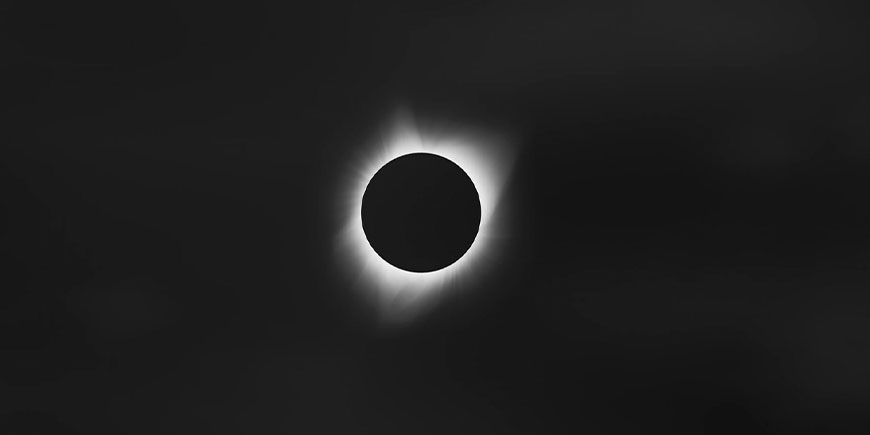
During a total solar eclipse, the obscuration produces a twilight similar to sunrise or
sunset, but which envelops the entire horizon. Total eclipses are spectacular and also
allow us to observe the solar corona, the outermost part of our star’s atmosphere, which
typically cannot be seen from Earth because it is “submerged” by the light of the solar disk.
It’s important not to confuse solar eclipses with lunar eclipses. Both phenomena are due to
an alignment of the Sun, Earth, and Moon, but the difference lies in the order of this
alignment: in solar eclipses, the Moon is between the Sun and the Earth, while in lunar
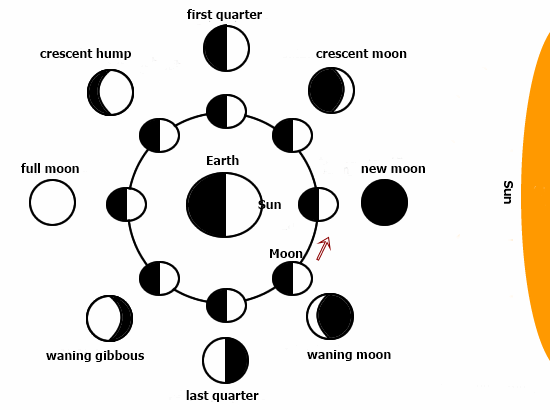
eclipses, the Earth is between the Sun and the Moon. Solar eclipses therefore occur
during the new moon phase, while lunar eclipses always occur during the full moon phase.
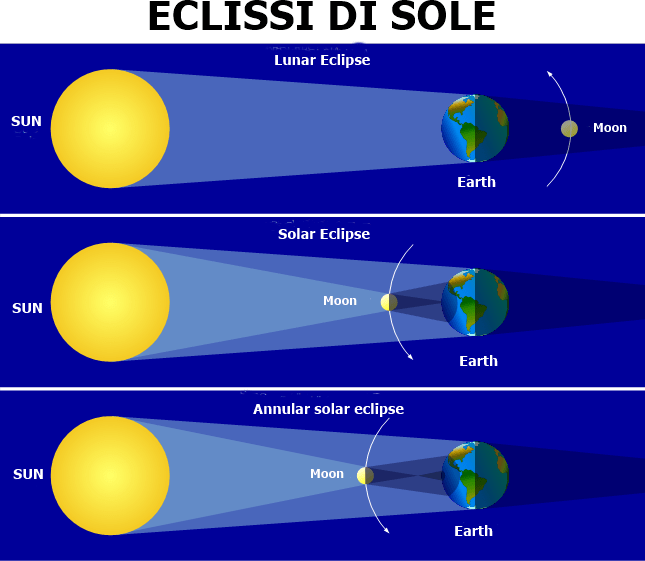
The phenomenon of a solar eclipse is due to a geometric coincidence: from an observation
point on Earth, the lunar disk and the solar disk appear to be comparable in size: the Sun
has a diameter about 400 times greater than that of the Moon, but is also about 400 times
more distant.
When a solar eclipse occurs, the Moon’s shadow is cast on a relatively small area of the
Earth; this circular area is surrounded by a larger region that during the eclipse is not in
shadow but in penumbra. As the Earth rotates on its axis and—more slowly—around the
Sun, the bands of shadow and penumbra move along the Earth’s surface, tracing curves
that can be thousands of kilometers long.
A total (or annular) eclipse occurs in the shadow zone, while it is always partial in the
penumbra zone.
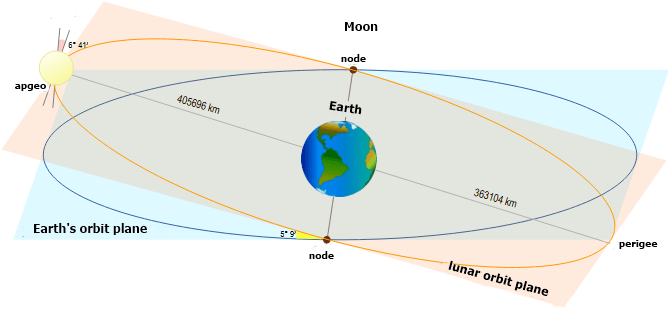
You might ask: if the Moon orbits the Earth in about a month, why don’t solar eclipses
occur every month? The answer lies in the fact that the Moon’s orbit is in a plane inclined
by about 5° compared to the Earth’s orbit. This means that, for most new moons, our
satellite’s shadow will be outside the Earth’s orbital plane and therefore will not hit the
Earth. If the two orbital planes coincided, however, every new moon would be a solar
eclipse!
Not all solar eclipses are the same. They can be classified into four types: partial eclipses,
total eclipses, annular eclipses, and hybrid eclipses.
PARTIAL SOLAR ECLIPSES
The Moon’s alignment between the Earth and the Sun is not always perfect, resulting in
the Moon covering only a portion of the solar disk. In these cases, we speak of partial solar
eclipses.
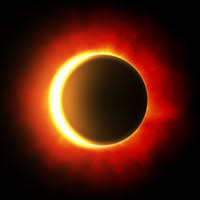
TOTAL SOLAR ECLIPSES
When the alignment of the Sun, Moon, and Earth is such that the Moon completely covers
the Sun, we speak of a total solar eclipse.
ANNULAR SOLAR ECLIPSES
A perfect alignment of the three celestial bodies, however, does not guarantee a total
eclipse. The Moon, in fact, is in an elliptical orbit around the Earth (as established by
Kepler’s first law), and therefore its distance from us is not always the same: it ranges from
about 356,000 km at the point of its orbit closest to Earth (perigee) to about 406,000 km at
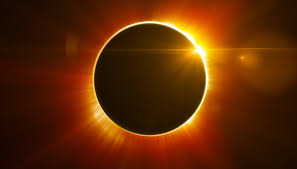
its farthest point (apogee). If the Moon causes an eclipse during apogee, its disk will
appear slightly smaller, enough to reveal a “bright ring” on the edge of the solar disk. In
this case, we will have so-called annular solar eclipses.
Hybrid Solar Eclipses
Then there are hybrid solar eclipses, which change from annular to total, or vice versa,
depending on how the Moon’s shadow falls on the Earth’s surface.
To stay updated, visit our website www.fotootticadeganello.com
Foto Ottica Deganello
Via Beato Pellegrino n° 51
35137 Padova tel. +39 049/2951766
www.fotootticadeganello.com


Devi effettuare l'accesso per postare un commento.